
There’s a good probability that Fort Davis will figure into your West Texas road trip itinerary. Spend a whole weekend here since Fort Davis has so many fantastic things to do and let me help you arrange your vacation.
One of those unassuming tiny villages that takes your breath away is Fort Davis. That’s how we felt, at least. We really enjoyed our time in this little village. It’s still one of our top West Texas vacation spots. Despite having a population of 1,099, Fort Davis offers a wide range of activities. From taking a picturesque drive to hiking at a state park, stopping by a vineyard, partying outside, and more. Let’s take a look at the list of top things to do in Fort Davis 2024.
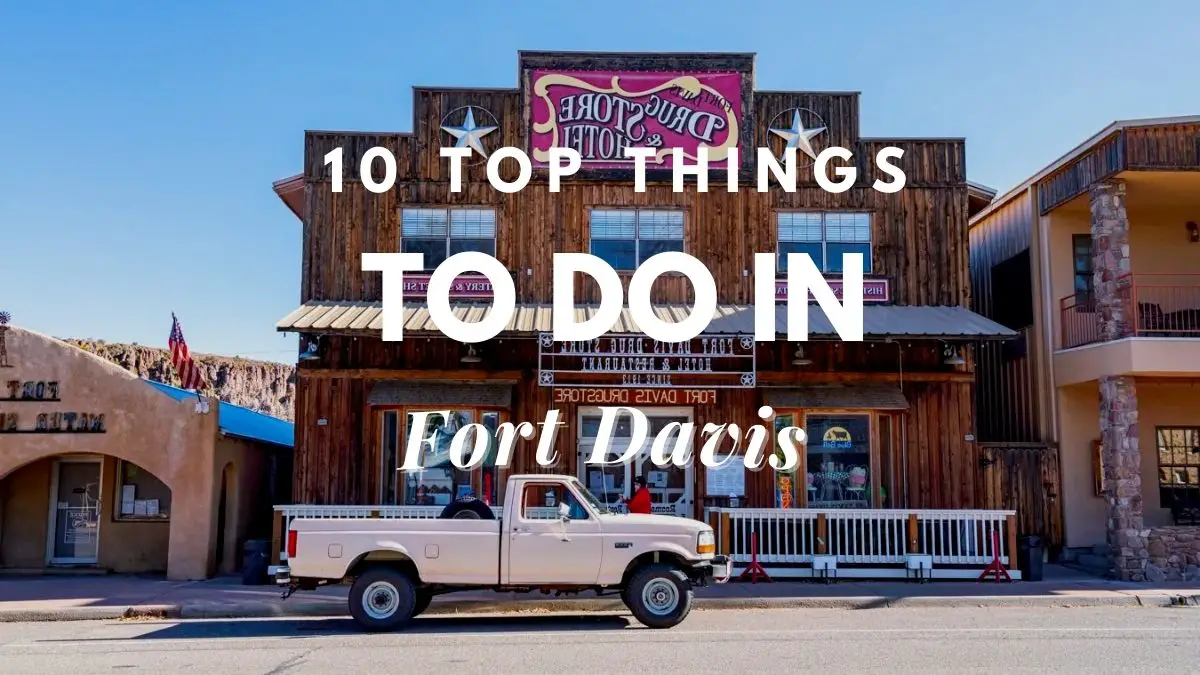
What is Fort Davis all about?
Fort Davis, Texas’s highest town at 5,050 feet above sea level, has lower temperatures than most other places in the Lone Star State. As a result, Fort Davis is a delightful destination all year long. The town boasts a rich history, beautiful mountain ranges, the greatest stargazing, and a welcoming local population. Pioneers, ranchers, cowboys, Mexicans, Buffalo Soldiers, Mescalero Apache, and Comanche people from the United States and the Southwest have all crossed paths here at various points in history.
From 1854 through 1891, Fort Davis left its imprint as an important military outpost for the Southwest. The community has kept its past and grown into one of Texas’ top tourist destinations today. One of the finest things to do in West Texas is to pay a visit to Fort Davis, which is full of American history, outdoor activities, astronomy, picturesque mountains, and beauty. Following are 5 must-do activities in Fort Davis.
1. McDonald Observatory
The finest thing to do in Fort Davis is to visit the McDonald Observatory. Both day and night are good times to go, but the evening is the best. Mount Locke and Mount Fowkes in the Davis Mountains are home to the McDonald Observatory. The night sky there is among the darkest in the whole United States.
Visitors may take in breathtaking views of the area throughout the day. Visitors may experience some of the greatest astronomy in the world at night. You’re still in for a treat even if you can only visit the McDonald Observatory during the day. Visitors to the telescope park may learn about the history of the Observatory and the current research being conducted during a 90-minute guided tour of the facility.
I strongly advise going to the Observatory at night to take part in the Evening Sky Viewing and Star Party if you have the time. An expert member of staff leads the evening sky viewing at the amphitheater, enlightening, and assisting visitors in locating prominent constellations, brilliant stars, planets, and satellites. The Evening Sky Program is followed by the start of the Star Party.
Visitors to the Star Party may witness live images of various astronomical discoveries using a telescope/camera combo projected onto a giant screen while sitting outdoors. At our Star Party, we saw two galaxies, an asteroid, a nebula, and a star cluster.
2. Visit Davis Mountains State Park
Spend the day in Davis Mountains State Park if you like being outside, birdwatching, and/or hiking. The hilly terrain, hiking and biking trails, birding, CCC heritage, picturesque drive, and distinctive on-site lodging make this panoramic park one of the greatest Texas State Parks.
The finest attractions of Davis Mountains State Area do not need you to ride or trek on the trails, which is what I love most about the park. The historical sites, bird watching locations, and breathtaking vistas are all conveniently accessible by automobile. The cherry on top is hiking or riding the routes.
The King’s Table, the Indian Lodge, and the frontier fort must all be seen when visiting Davis Mountains State Park. The nicest aspect is that you may travel the beautiful Skyline Drive or use hiking and biking paths to reach each location.
The 1.6-mile Old CCC Path to the 2.6-mile Skyline Drive Trail is the ideal hiking trail if you wish to go hiking. This intermediate loop takes around 3.5 hours to complete on average.
3. Visit the Indian Lodge
One of the nicest things to do in Fort Davis is to stay at The Indian Lodge, a white adobe hotel within Davis Mountains State Park. Within Davis Mountains State Park, there is a stunning white adobe hotel called the historic Indian Lodge. Although it makes a beautiful spot to stay, anybody may go there and visit. You really must see it; it is undoubtedly among the top things to do in Fort Davis.
The Civil Conservation Corps (CCC) hand-built the lodge using local wood, making the hotel historic. In addition, the majority of the antique furniture is authentic and dates to 1933. You may eat at the on-site Black Bear restaurant in addition to going to the Indian Lodge and sleeping there. Wednesday through Sunday, the restaurant serves breakfast and lunch and has a wide selection of delectable meals.
4. Visit the Fort Davis National Historic Site to Travel Back in Time
One of the finest things to do in Fort Davis is to visit the Fort Davis National Historic Site, which is a must-see for history fans. A line of renovated fort structures is framed by the Davis Mountains. One of the finest things to do in Fort Davis, regardless of whether you like history, is to visit the Fort Davis National Historic Site. When you go to the fort, you really do feel as if time has stood still.
In summary, Fort Davis was important to the history of the American Southwest and its western border. It served as the main military outpost on the San Antonio-El Paso Road, which was used by emigrants, freighters, mail coaches, and other passengers to reach California.
I advise viewing the 15-minute movie on the history of the fort if you want in-depth knowledge. In addition, you may explore the remains and enjoy a self-guided tour of the five renovated and restored structures.
The bugle cries are among the Fort Davis National Historic Site’s coolest features. There are bugle calls that correspond to the soldier’s daily schedule while you are on the premises. To learn what each planned bugle call meant for the troops, be sure to pick up the bugle call pamphlet at the tourist center.
5. Take a ride on the 75-Mile Scenic Loop
The Fort Davis Scenic Loop is 75 miles long, so you may not need to travel the full 75 miles of it, but you must drive at least some of it. Your breath will stop as you complete this scenic loop across the mountains and valleys.
It will probably take two hours to travel the whole 75 miles if you don’t stop. Believe me. You’ll pause to snap photographs and enjoy the surrounding natural splendor.
State Highway 118N in the direction of Davis Mountains State Park and the McDonald Observatory is one of our favorite sections of the Fort Davis Scenic Loop. This is the one I advise if you plan to travel any distance. It is breathtaking, particularly around dusk.
6. Ride a horse across the Davis Mountains.
A ride over the Davis Mountains on horseback in Fort Davis will round off your vacation through West Texas. Visitors aged 6 and up may take a guided horseback ride on routes through gorgeous scenery at Prude Ranch.
Visitors may arrange one- to two-hour guided horseback excursions on the stunning paths. These paths wind around mountains, cross waterways, and through green pastures. Additionally, “Buckaroo rides” are available for young visitors aged five and younger. The nicest horse in the corral will be chosen by the guide, who will keep charge of it while the little cowboy or cowgirl does a few circuits.
7. Visit the Chihuahuan Desert Botanical Garden to View Unique Cacti
One of the nicest things to do in Fort Davis is a vivid green cactus in the botanical garden at the Chihuahuan Desert Botanical Garden. One of Fort Davis’s best-kept secrets is the Chihuahuan Desert Research Institute (CDRI). Over six miles of hiking paths, a botanical garden, a mining heritage exhibit, and the Cactus Museum Collection are all located at CDRI.
Although there is a lot to discover at the CDRI, you must see the Cactus Museum Collection, which has one of the biggest collections of cactus from the Chihuahuan Desert in the world. One of the nicest things to do in Fort Davis is just this.
Within the botanical garden, in a greenhouse, is the Cactus Museum Collection, which has over 200 different kinds and variations of stunning cacti and succulents. We had such a great time that when we got home, we went out and purchased cacti and succulents.
8. Visit the World’s Biggest Rattlesnake Exhibit.
Visit Rattler’s and Reptiles, dubbed the “biggest rattlesnake display in the world,” if you don’t mind snakes, spiders, and other creepy crawlies. Over 100 reptiles, amphibians, tarantulas, insects, and indigenous desert animals may be seen at Rattler’s & Reptiles, along with 19 different kinds of rattlesnakes. This show is indeed impressive, as is obvious. Additionally, if you like seeing these species in the wild, this is a Fort Davis event you must not miss.
9. Try homemade gin made from native junipers in Texas
At the Blue Mountain Bar and Grill in Fort Davis, a bottle of WildBark from WildGins Co. is placed next to a green cocktail. Trying gin made from juniper berries collected in the Davis Mountains is one of the most unique and wonderful things to do in Fort Davis. The native Texas juniper berries contribute to the distinctive flavor that makes this gin stand out from all others you have tried.
The only gin manufacturer in the world, WildGins Co., uses natural Texas junipers that are hand-harvested in the Davis Mountains. The gin is made in the WildGins Co. offices in Austin despite being foraged near Fort Davis.
Having said that, Blue Mountain Bar & Grill is the ONLY location in Fort Davis where you can try WildGins Co. So walk up to the bar and request the WildGins Co. on the rocks or the trademark Geoff’s Balmorhea Springs cocktail.
10. Experience Wine Tasting with Beautiful Views
Visit Blue Mountain Trail Vineyard and Chateau Wright Winery for a delightful wine tasting and breath-taking Davis Mountain vistas. In the American Viticultural Area (AVA) Davis Mountains area, Chateau Wright is a sustainable winery. The vineyard benefits from the best soil and climate in this area because to its greatest elevation and lowest temperatures, which allow it to produce a variety of grape varieties.
From Friday through Sunday, 12 pm – 7 pm, guests may visit Chateau Winery for a wine tasting, a few things to eat, and beautiful vistas.
Final words
Now you know the best activities available for you to engage with in Fort Davis. Take a look at these activities and come up with a proper plan, so that you can get the most out of your experience.

Proud owner of https://travelyouman.com/
