
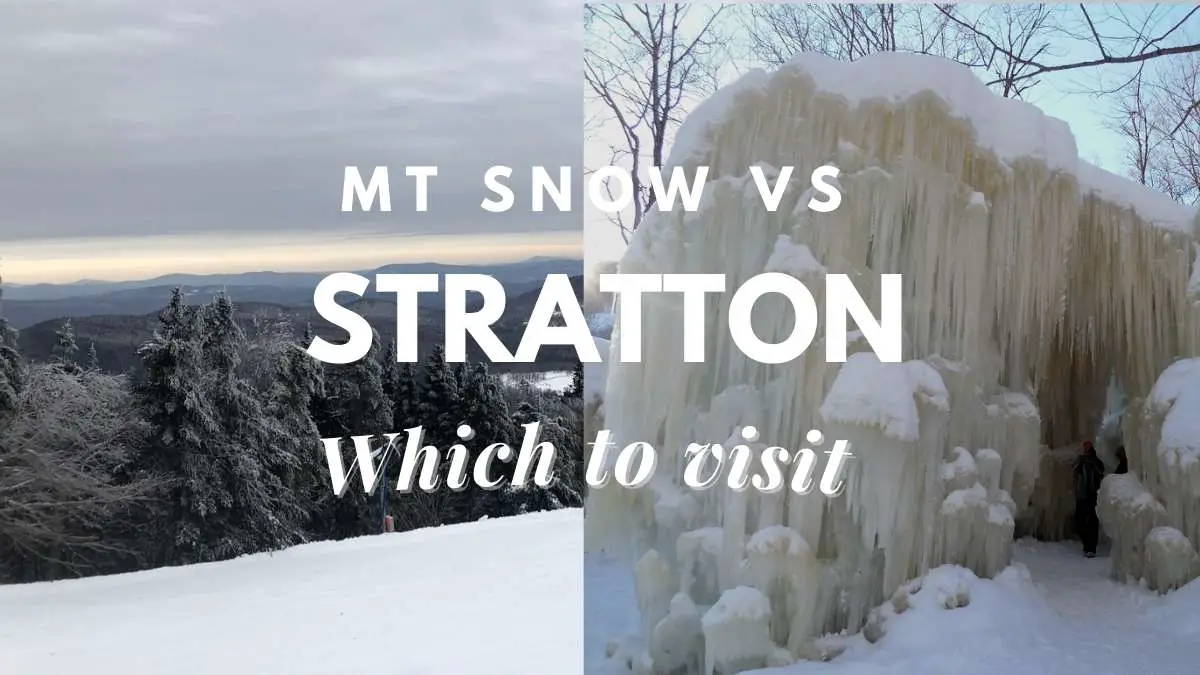
As you would expect, there are several options for skiing in Vermont. Winters in this part of the world are associated with snow, and with snowsports such as skiing, cross-country skiing, snowshoeing, and even snowmobiling. The Harris Ski Jump is famed in the Brattleboro region, but it also has some of Vermont’s greatest skiing. On this Mt Snow vs Stratton guide, we are going to help you figure out the best place to visit.
From the professional skier to the novice, Vermont ski resorts offers something for everyone. The nearest ski resort in Vermont is Mt. Snow, although Stratton Mountain isn’t too far away for an exciting day on the slopes. The Brattleboro Ski Hill is a terrific alternative if you’re searching for something a little smaller and more local. It’s difficult to go wrong in Vermont when there are so many amazing skiing alternatives nearby!
Mount Snow
Mount Snow, in the Green Mountains, is just 30 minutes away from our Vermont bed & breakfast. Mount Snow is the nearest destination for skiing in Vermont for several large urban centers on the east coast. Because it’s part of the Vail Resorts Group, Epic Pass subscribers may ski here.
The majority of the mountain is devoted to intermediate routes, although there is also ample of terrain for novices and experts. There is a 1,700-foot vertical drop here, and 20 lifts transport skiers to their routes. A 10-acre terrain park is also available for skiers and snowboarders to explore.
Spend an afternoon or morning walking around the town. Book a massage at the day spa or shop for outdoor gear or presents. If the town doesn’t have what you’re searching for, go to Manchester’s designer outlet stores, which are just 30 minutes away by vehicle.
Hikers flock to Stratton Mountain throughout the summer months. Attempt to cross the mountain on portions of the Appalachian Trail and the Long Trail. Cool off at adjacent Emerald Lake State Park or Jamaica State Park, which both have swimming areas. Golfing, kayaking, and biking are some of the other summer activities offered on or around the mountain.
Make a workout appointment at the Stratton Training and Fitness Center, which has cardio and weight training equipment as well as an indoor saltwater pool. Relax in the steam room or the hot tub.
Read: Is Traveling A Hobby? The Ultimate Guide To An Exciting Way Of Life
Learn about the Downsides Of Traveling As A Hobby
Stratton Mountain
Stratton Mountain is about an hour’s drive away. Vermont, on the other hand, has a wide range of skiing options, including 99 lines, glades, and rapid lifts to get you on the snow faster. It was the site of the first high-speed six-passenger lift in New England.
Because Stratton Mountain is home to the state’s highest peak, the vertical drop here is spectacular, coming in at little over 2,000 feet. Their routes are also well-spaced, offering a choice of ski lines to suit skiers of all levels.
Stratton Mountain is most recognized for its association with snowboarding, since it was one of the first resorts to promote the sport in the 1980s. In the winter, join other snowboarders and skiers on the slopes, experience the breathtaking mountain vistas, and shop in the lovely slope-side town.
In the winter, the Stratton Mountain Resort, which is situated on one of the highest peaks in Southern Vermont, is the hub of activity. Get suited for skis and explore the 97 paths that cover over 100 acres (0.5 square kilometers) of glades and over 600 acres (2.5 square kilometers) of skiable terrain.
The Stratton Gondola will take you to the top of the mountain. Views of the neighboring mountain summits may be seen from the top. While mountain exploration, stop by one of the on-mountain eateries for a warm drink.
What is the best place to visit?
You’d think two resorts that close together would be similar, and they are in certain respects. I’ve lately experienced both types of skiing, and here’s how they differ. To begin, both Stratton and Mount Snow have invested heavily in lifts, snowmaking, and grooming, and it shows; both are terrain park and competition powerhouses. Both are popular among skiers and bikers.
However, they are distinct enough that you are likely to choose one over the other based on those distinctions – at least on any given day. Let’s start with one small difference: Mount Snow is a bit easier to get to than Stratton from most areas. However, this might imply fewer people at Stratton. It’s up to you to decide who has the upper hand here.
The parallels in snow quality are apparent – and not by chance. When Mother Nature doesn’t cooperate with natural snow, Mount Snow, which was one of the first regions in New England to make a serious commitment to snowmaking and grooming, is once again among the go-to resorts. The quality of the snowmaking and grooming has increased dramatically since Peak Resorts took control.
The fact that Stratton routinely provided some of the greatest snow conditions in New England was the major reason they had to undertake these modifications. In dry years, when their massive snowmaking pond (one of the nicest summer swimming holes ever) offers them more water to work with, Stratton still has an edge, but in normal years, I’d call it a tie.
It’s a toss-up when it comes to lift capacity. Stratton features a summit gondola and three detachable six-packs, while Mount Snow has 20 lifts. Both regions feature several out-of-the-way elevators that seldom have a line on busy days. Stratton has unfortunately eliminated the Kidder brook lift, which was one of my favorites for this.
When it comes to lift tickets, the two are very equivalent. Adult weekend/holiday lift tickets are $75 at Mount Snow and $84 at Stratton. What about the terrain? Mount Snow has the edge when it comes to pure diversity. Nothing at Stratton compares to Ripcord on Mount Snow’s North Face in terms of steepness and difficulty. But, in my view, Stratton offers more and nicer glades for tree skiing when the snow is thick.
They are both equipped with numerous terrain parks for people of all abilities. Stratton, in general, offers more intriguing intermediate terrain, although not by much. On both summits, novices have enough of ground to explore. The contrast between Stratton and Mount can be found in the mountain’s feel. Mount Snow has nicer base lodges and caters more to day guests, whilst Stratton caters to multi-day visitors (they offer some incredible ski-and-stay packages).
While Mount Snow has a few ski condominiums and a slope side hotel nearby, the base area remains deserted when the lifts close. You’ll almost certainly need a vehicle, however some of the nearby inns provide accommodation, eating, and shuttle services. On the other hand, Stratton offers a true slope side hamlet with many of stores and restaurants. When you arrive, park your vehicle, and don’t move it till you go.
In certain respects, Stratton and Mount Snow are distinct, and one may suit you better than the other. But I can’t recall ever spending a day at any of them that I didn’t greatly like.

Proud owner of https://travelyouman.com/
